

How Does Emergency Department Triage Work in WA? A Simple Guide to Who Gets Seen First
Why Someone Who Arrived After You Might Be Seen Before You
You arrive at a busy Emergency Department in Perth. You check in, speak with the triage nurse and take a seat. Twenty minutes later, another patient walks through the door. Within minutes, they are taken straight into the Emergency Department. Meanwhile, you are still sitting in the waiting room.
It can be frustrating. It can also be confusing. You may naturally think: “I was here first. Why are they being seen before me?”
The answer is triage.
Emergency Departments in Western Australia do not normally operate on a first-come, first-served basis. Instead, patients are prioritised according to clinical urgency.
That means the person who is at greatest immediate risk is generally treated first, regardless of whether they arrived five minutes ago or an hour ago.
Western Australian Emergency Departments use the Australasian Triage Scale, commonly known as the ATS.
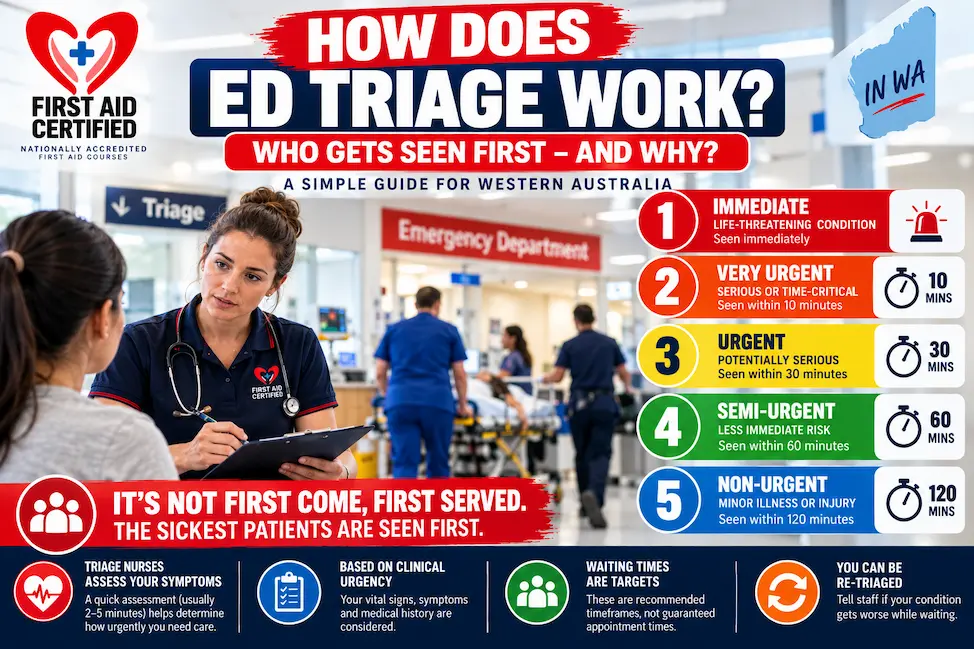
The ATS divides patients into five urgency categories, from Category 1 requiring immediate treatment through to Category 5, where the recommended maximum treatment time is 120 minutes.
The goal is simple: get the sickest and most time-critical patients treated first. This guide explains how Emergency Department triage in Western Australia works, what the five triage categories mean, why waiting times change, what information the triage nurse needs and what you should do if you become more unwell while waiting.
What Does “Triage” Mean?
Triage is a system used to rapidly decide how urgently a patient needs medical assessment and treatment.
When many people arrive at an Emergency Department at the same time, staff need a safe and consistent method of deciding which patient needs attention first.
Imagine an Emergency Department receives these five patients almost simultaneously:
- Someone with a sprained ankle
- Someone with severe chest pain
- Someone with a minor rash
- Someone who has stopped breathing normally
- Someone with a badly broken arm
It would clearly not be safe simply to treat them in the order they walked through the door.
The person who is not breathing normally needs immediate treatment. The person with potentially serious chest pain may also need very rapid assessment. The ankle injury and rash can generally wait longer if those patients remain stable.
That is the basic idea behind triage. The Australasian Triage Scale is a clinical tool for prioritising patients according to clinical urgency and directing them toward the appropriate area for assessment and treatment.
Who Performs Triage in a WA Emergency Department?
When you arrive at an Emergency Department, one of your first clinical contacts will generally be with a specially trained triage nurse or appropriately trained clinical assessment staff member.
The triage assessment is deliberately relatively quick. A typical initial assessment may take only a few minutes because the aim is to identify clinical urgency rather than complete the entire medical assessment.
The triage nurse may ask questions such as:
- What happened?
- Why have you come to Emergency?
- When did the problem begin?
- Are your symptoms getting worse?
- Where is your pain?
- How severe is the pain?
- Are you having difficulty breathing?
- Have you lost consciousness?
- Are you bleeding?
- What medical conditions do you have?
- What medications are you taking?
Depending on your situation, staff may also obtain observations such as:
- Heart rate
- Blood pressure
- Respiratory rate
- Oxygen saturation
- Temperature
- Level of consciousness
The goal at this point is not necessarily to make your final diagnosis. The immediate question is: How quickly does this person need assessment and treatment?
The Five Emergency Department Triage Categories in WA
Western Australian Emergency Departments use five categories under the Australasian Triage Scale.
| Category | General urgency | Recommended maximum time |
| 1 | Immediate / life-threatening | Immediate |
| 2 | Emergency / very urgent | 10 minutes |
| 3 | Urgent | 30 minutes |
| 4 | Semi-urgent / standard | 60 minutes |
| 5 | Non-urgent / less urgent | 120 minutes |
These timeframes are clinical urgency targets within the ATS system. They are not guaranteed appointment times. Emergency Department crowding, simultaneous critical emergencies, staffing and available treatment areas can all influence actual waiting times.
Triage Category 1 – Immediate
Recommended treatment time: Immediately
Category 1 is the highest possible triage priority. These are people who have an immediately life-threatening condition and require simultaneous assessment and treatment.
A Category 1 patient is not expected to sit in the waiting room. Treatment begins immediately.
Examples may include cardiac arrest, respiratory arrest, profound unconsciousness or extremely unstable critical illness or injury.
Imagine someone arriving with no normal breathing following a cardiac arrest. It does not matter that 25 other people are already waiting. That person immediately becomes the clinical priority.
This is one reason Emergency Departments can suddenly slow down. A single critically ill patient may require several doctors and nurses, resuscitation equipment, airway management, CPR, medication, defibrillation, urgent imaging and specialist teams. From the waiting room, you may not see any of this happening.
Triage Category 2 – Very Urgent / Emergency
Recommended treatment time: Within 10 minutes
Category 2 patients have conditions considered imminently life-threatening or extremely time-critical. They require very rapid medical assessment.
Presentations can include serious chest pain, significant difficulty breathing, very severe pain, critical illness or severe injury, depending on the patient’s full clinical picture.
Two people can both say, “I have chest pain,” but receive different urgency categories because their age, symptoms, observations, history and overall clinical appearance may be very different.
Triage Category 3 – Urgent
Recommended treatment time: Within 30 minutes
Category 3 generally includes patients with a potentially life-threatening condition, an important time-critical treatment need or significant illness or injury.
Examples can include significant illness, heavy bleeding from cuts, major fractures or significant dehydration, depending on the clinical circumstances.
A Category 3 patient may appear reasonably stable while still needing assessment relatively quickly. Looking ‘okay’ does not necessarily mean someone is not seriously unwell.
Triage Category 4 – Semi-Urgent / Standard
Recommended treatment time: Within 60 minutes
Category 4 is commonly allocated to conditions that require medical attention but are less immediately threatening.
Examples can include sprained ankles, migraine, earache, some eye problems and other less urgent injuries or illnesses.
Being classified as Category 4 does not mean nothing is wrong. It means that, based on the triage assessment, other patients may safely need treatment sooner. If several Category 1, 2 or 3 patients arrive, a Category 4 patient’s wait can become longer.
Triage Category 5 – Non-Urgent
Recommended treatment time: Within 120 minutes
Category 5 is the lowest urgency category on the Australasian Triage Scale.
It can include minor illnesses, minor aches or pains, some rashes and chronic or minor problems without concerning clinical features.
These patients may face a longer wait when the Emergency Department is busy because higher-acuity patients are being prioritised ahead of them.
Why Chest Pain Can Be Seen Quickly
Chest pain provides a good example of how triage works. Chest pain has many possible causes. Some are relatively minor; others may represent a heart attack, pulmonary embolism, aortic disease or another time-critical condition.
The triage nurse therefore considers much more than the words ‘chest pain’. They may consider how suddenly it started, where the pain is, associated shortness of breath, sweating, nausea, collapse, medical history, age, vital signs and the general appearance of the patient.
A patient who appears seriously unwell may be moved through very quickly.
The Waiting Times Are Not Appointment Times
If you are classified Category 3 and the ATS says 30 minutes, that does not mean a doctor is guaranteed to see you at exactly the 30-minute mark.
These are recommended clinical urgency timeframes and health-system performance measures. A major hospital can suddenly receive a cardiac arrest, serious car crash, multiple ambulance arrivals, severe breathing problems, a stroke or a critically ill child.
Clinical resources must then move toward the highest-risk patients. That can extend the wait for less urgent cases.
Why Does Someone Who Arrived Later Get Called First?
Because arrival time is not the main priority. Clinical urgency is.
Suppose you arrived at 2:00 pm with a painful sprained ankle. At 2:20 pm, another person arrives with severe chest pain, sweating and difficulty breathing.
You may understandably think, ‘But I’ve already waited 20 minutes.’ However, the second patient may be at substantially greater immediate risk. They can therefore be moved ahead.
It Isn’t Really a Queue
One helpful way to understand an Emergency Department is to stop imagining it as a supermarket queue. There is not simply one line.
Instead, think of the ED as several clinical pathways operating simultaneously. Patients may be moved into resuscitation, acute treatment areas, fast-track areas, paediatric treatment areas, mental health assessment areas, observation areas or other specialised streams.
That means you may sometimes see someone who appears less unwell being called before you. They may be moving through a different clinical stream with different staff and resources available.
Why Can the Waiting Room Look Empty While the ED Is Busy?
You may look around and see only a handful of people in the waiting room while staff tell you the Emergency Department is extremely busy. Both things can be true.
Behind the waiting-room doors there may be ambulance arrivals, patients being resuscitated, people awaiting scans, patients requiring constant monitoring, observation patients, specialist reviews and people waiting for inpatient hospital beds.
The visible waiting room is only one small part of the Emergency Department.
Does Arriving by Ambulance Mean You Get Seen First?
Not automatically. Calling an ambulance does not provide a shortcut to the front of an Emergency Department queue.
Ambulance patients are still assessed according to their clinical condition. A critically ill ambulance patient will be treated urgently, but a clinically stable ambulance patient may still wait while more urgent patients receive care.
The principle remains the same: priority is based on clinical requirement rather than the method of arrival.
What Happens if Your Condition Gets Worse While Waiting?
Tell the triage staff. Do not assume that because you have already been triaged you simply have to wait silently.
Triage is not necessarily a once-only decision. Patients can be reassessed and re-triaged if their clinical condition changes.
Tell staff if you develop new or worsening chest pain, difficulty breathing, collapse or faintness, confusion, severe pain, bleeding, weakness, drowsiness, vomiting or any other change that concerns you.
Do not quietly sit in the corner hoping someone notices.
Can Your Triage Category Change?
Yes. If your condition deteriorates, staff can reassess you.
Emergency medicine is dynamic. Someone who initially appears reasonably stable may become significantly more unwell. That is why triage systems include reassessment and re-triage.
Aishwarya’s CARE Call in Western Australia
Western Australia has an escalation process called Aishwarya’s CARE Call. It is available in WA public hospitals for patients, carers and families who are worried that they or someone they care for is becoming sicker.
The process begins by telling a nurse or staff member you are concerned. If you remain worried, ask to speak to a senior staff member. If the concern remains urgent, use the hospital’s Aishwarya’s CARE Call process to escalate the concern to a dedicated senior staff member.
Different hospitals have different CARE Call contact details, so follow the information displayed at the hospital you are attending.
How Does Triage Work for Children?
The underlying principle is the same: the sickest child receives the highest priority.
However, parents and carers can provide extremely valuable information about whether a child is behaving differently from normal.
For example, a parent might say, ‘She normally talks constantly, but she hasn’t spoken for the last hour.’ That information can be clinically important even if the child initially looks quiet rather than obviously distressed.
Does Severe Pain Affect Triage?
It can. The ATS considers clinical urgency rather than just the diagnosis.
Severe pain may contribute to a more urgent assessment depending on the overall presentation. However, a pain score alone does not automatically determine the category.
The nurse considers the location and cause of pain, whether onset was sudden or gradual, vital signs, associated symptoms, appearance and relevant medical history.
Mental Health Emergencies Are Triaged Too
Triage is not only for physical injuries and illness. Mental health emergencies are also assessed according to clinical urgency.
A person at immediate risk of serious harm may receive urgent assessment just as someone with a serious physical emergency would.
What Information Should You Tell the Triage Nurse?
Give staff clear, truthful information. Useful information includes what happened, when it happened, your main symptom, whether symptoms are changing, your medical history, medications, allergies and relevant recent events such as surgery, pregnancy, recent illness or new medication.
If you have a medication list or relevant medical information available, bring it with you where practical. Accurate information helps clinicians make safer decisions.
Should You Exaggerate Symptoms to Get Seen Faster?
No. Accurate triage relies on accurate information. Exaggerating symptoms can interfere with clinical decision-making.
Do not minimise important symptoms either. Describe exactly what you are experiencing and let the trained clinician assess the urgency.
What Happens After Triage?
Depending on your urgency and the hospital’s available resources, you might go directly to a treatment area, be asked to wait, have observations taken, receive an ECG, undergo blood tests, have imaging ordered or be assessed by nursing and medical staff.
After assessment you may be discharged, observed for several hours, treated, referred for follow-up or admitted to hospital.
Additional delays can occur while people wait for investigations, specialist decisions or an inpatient hospital bed.
Triage Does Not Tell You How Serious Your Final Diagnosis Will Be
Triage measures urgency. It is not necessarily a measure of final diagnosis, complexity, how long treatment will take, whether you will be admitted or how serious the eventual diagnosis will turn out to be.
Someone may be Category 4 but require complicated investigations. Another patient may initially be Category 2 because a dangerous condition needs to be ruled out rapidly, but ultimately be discharged home.
Triage determines how quickly assessment should begin, not the final outcome.
When Should You Go to an Emergency Department?
Emergency Departments are designed for people needing urgent medical attention. For a medical emergency, call Triple Zero – 000.
Potentially serious emergencies can include cardiac arrest, severe breathing difficulty, serious chest pain, major trauma, severe bleeding, serious allergic reactions, stroke symptoms, unconsciousness, severe burns or serious poisoning.
If you believe you have a genuine medical emergency, do not delay seeking emergency help because you are worried about waiting times.
What if the Problem Isn’t an Emergency?
Not every medical problem requires an Emergency Department. Depending on the condition and availability, alternatives can include your GP, a Medicare Urgent Care Clinic, pharmacy services or Healthdirect.
The right option depends on the problem and how unwell the person is. If in doubt about a potentially life-threatening emergency, call 000.
Can You Check Perth Emergency Department Waiting Times?
WA Health publishes information showing current activity at participating Emergency Departments.
However, displayed waiting times are general information rather than a prediction of exactly how long you personally will wait. Your individual priority depends on your own clinical assessment and triage category.
A Simple Way to Understand ED Triage
Imagine five people arrive at approximately the same time:
Patient A: No normal breathing after cardiac arrest. Likely extremely urgent. Immediate resuscitation is required.
Patient B: Serious chest pain and significant breathing difficulty. Very urgent. Rapid assessment may be required.
Patient C: Heavy bleeding from a significant wound but currently conscious and stable. Urgent. Relatively rapid treatment may be required.
Patient D: Sprained ankle, stable observations and no major complications. Less urgent. May wait while higher-acuity patients are treated.
Patient E: Minor rash with no other concerning symptoms. Lowest urgency of this group and may wait longest.
This is only an illustration. Actual ATS categories are assigned by trained clinicians after assessing the individual patient’s circumstances.
Why Understanding Triage Matters in First Aid
First Aid and triage have something important in common: both involve recognising priorities.
In First Aid, we teach people to identify immediate threats to life. Using DRSABCD, for example, the responder first considers Danger, Response, Send for help, Airway, Breathing, CPR and Defibrillation.
If someone is unconscious and not breathing normally, that problem takes priority over minor cuts and bruises.
Emergency Department triage uses a much more sophisticated clinical system, but the underlying idea is similar: deal with the greatest immediate threat first.
First Aid Courses Perth – Learning to Recognise Medical Emergencies
At First Aid Certified, our First Aid Courses Perth focus on practical emergency-response skills.
Training can help students recognise and respond to situations including cardiac arrest, choking, anaphylaxis, asthma, bleeding, burns, seizures, medical emergencies and injuries.
Knowing when someone needs urgent emergency help is an important part of First Aid.
Our practical training is available from our dedicated training centres in Subiaco, Innaloo and Joondalup, with First Aid, CPR, Childcare First Aid and other nationally recognised training options available.
Ready to build practical emergency skills?
Book a First Aid or CPR course with First Aid Certified in Perth:
BOOK ONLINE – firstaidcert.com.au/book-now/
Emergency Department Triage WA – Frequently Asked Questions
Does the first person to arrive get treated first?
Not necessarily. WA Emergency Departments prioritise patients according to clinical urgency, not simply arrival order.
How many triage categories are there?
Five. Category 1 is the most urgent and Category 5 is the least urgent.
What is Category 1?
An immediately life-threatening condition requiring immediate assessment and treatment.
What is Category 2?
A very urgent or imminently life-threatening condition with a recommended maximum treatment timeframe of around 10 minutes.
What is Category 3?
An urgent or potentially life-threatening condition with a recommended maximum treatment timeframe of around 30 minutes.
What is Category 4?
A semi-urgent or potentially serious presentation with a recommended maximum treatment timeframe of around 60 minutes.
What is Category 5?
A less urgent or minor presentation with a recommended maximum treatment timeframe of around 120 minutes.
Are those waiting times guaranteed?
No. They are Australasian Triage Scale clinical urgency targets. Actual waiting times can be affected by Emergency Department demand and the number of higher-acuity patients requiring care.
Does arriving by ambulance put you at the front of the queue?
No. Patients are prioritised according to clinical need rather than how they arrived.
What should I do if I get worse while waiting?
Tell the triage nurse or another staff member immediately. Your condition can be reassessed and your triage priority can change.
What if I am worried staff aren’t recognising that I or my loved one is becoming sicker?
Speak to staff. WA public hospitals also use Aishwarya’s CARE Call, a three-step escalation process for patients, families and carers concerned about clinical deterioration.
Final Message: ED Triage Is About Urgency, Not Your Place in Line
The easiest way to understand Emergency Department triage in WA is this: it is not a queue.
Emergency Departments are constantly assessing risk. Someone who arrives after you may be called before you because their condition could deteriorate quickly without treatment. A person arriving by ambulance is not automatically first. A patient who looks reasonably well may still have a serious condition. And someone who has been waiting may become more urgent if their condition changes.
Western Australian Emergency Departments use the Australasian Triage Scale as a consistent framework: Category 1 – immediate; Category 2 – 10 minutes; Category 3 – 30 minutes; Category 4 – 60 minutes; Category 5 – 120 minutes. These are urgency targets rather than guaranteed appointment times.
So next time you are sitting in an Emergency Department and someone who arrived later disappears through the doors before you, remember: it may simply mean that, based on their clinical assessment, they cannot safely wait as long as you can.
Ultimately, that is what triage is designed to do: get the right patient to the right level of care at the right time.

