

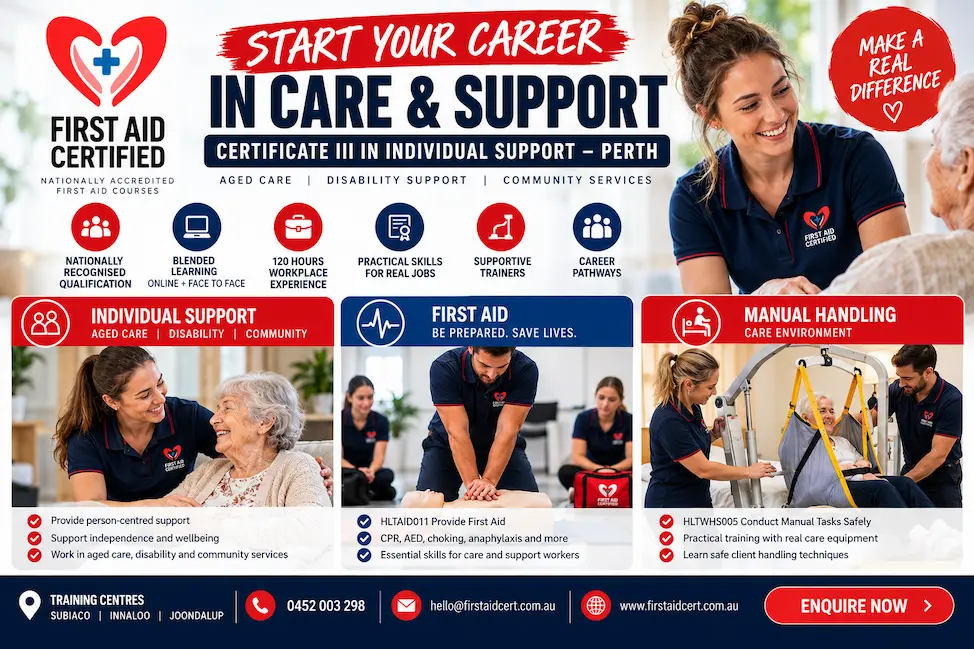
Certificate III in Individual Support Perth: Start a Career in Aged Care, Disability and Community Support
If you are considering a new career in aged care, disability support, home care or community services, the CHC33021 Certificate III in Individual Support is one of the most recognised starting points in Australia’s care sector.
For people searching for a Certificate III in Individual Support Perth, First Aid Certified is preparing a practical program combining face-to-face learning in Perth, online study and real workplace experience. The goal is simple: help students develop the practical skills, professional knowledge and confidence needed to work with people who may require support because of ageing, disability or other individual circumstances.
The nationally recognised CHC33021 Certificate III in Individual Support reflects work performed in community, home and residential care environments. Workers typically operate under supervision and delegation as part of a multidisciplinary team and provide person-centred support according to an individual’s support plan.
At First Aid Certified, we believe learning for the care sector should involve much more than sitting in front of a computer. Care work is practical. It involves people. It requires communication, judgement, compassion, safety awareness and confidence. That is why our planned Certificate III in Individual Support Perth combines face-to-face learning with flexible online activities and workplace experience. The current planned course fee is $2,999, the next intake is listed as coming soon, and training and assessment will be delivered in partnership with Safety Corp – RTO 91694.
| Important course distinction HLTAID011 Provide First Aid and HLTWHS005 Conduct Manual Tasks Safely are highly relevant complementary courses for care workers, but they should not be described as automatically included in the CHC33021 program unless they are specifically included in a student’s enrolment package. |
What Is CHC33021 Certificate III in Individual Support?
The CHC33021 Certificate III in Individual Support is a nationally recognised vocational qualification designed for people working in individual support roles. The qualification reflects work carried out in community settings, people’s homes and residential care environments.
Workers may support people who require assistance because of ageing, disability, health or other individual circumstances. The emphasis is on person-centred support. That means the worker is not simply completing tasks for another person. They are supporting the individual according to that person’s preferences, goals, rights, needs, abilities, choices and individualised support plan.
The qualification requires 15 units of competency, made up of 9 core units and 6 electives. It also requires at least 120 hours of workplace experience through the relevant assessment requirements. That workplace component is important because some of the most valuable learning happens when classroom knowledge is applied in real environments.
Certificate III in Individual Support Perth – A Practical Career Pathway
People enter the care sector from many different backgrounds. Some students are leaving school and looking for their first career. Others may have spent 10, 20 or even 30 years in another industry and want work that feels more meaningful. Some may already be working in community care but need a formal qualification. Others have spent years raising a family and are looking to return to the workforce.
The program may suit people who are starting a career in care or community services, changing careers, returning to the workforce, already working in the sector and seeking a qualification, or employers looking to develop existing workers.
There is no single type of person who becomes a good support worker. Communication skills, reliability, patience, respect for other people and a willingness to learn can all be incredibly important.
What Will You Learn in Certificate III in Individual Support?
The course is designed around much more than completing daily care tasks. Students develop skills across individualised support, independence and wellbeing, communication, diversity, legal and ethical practice, infection prevention and control, workplace safety, healthy body systems and person-centred support.
CHCCCS031 – Provide Individualised Support
Individual support starts with understanding that every person is different. Two clients with similar diagnoses or support needs may have completely different personal goals, preferences, abilities, daily routines, communication styles, family situations and cultural backgrounds.
This unit focuses on providing assistance according to an individual’s established support plan while respecting their dignity, choices and independence. Good support is not about automatically doing everything for someone. Sometimes the best support involves helping a person continue doing as much as they safely can themselves.
CHCCCS038 – Facilitate the Empowerment of People Receiving Support
Empowerment is an important concept in aged care and disability support. A support worker should not unnecessarily take control of another person’s life. Instead, the worker should help the individual make choices, express preferences, understand options, participate in decisions and maintain control wherever possible.
People receiving support have rights. They should be treated as individuals rather than simply as clients, patients or a list of tasks that need completing. Developing this mindset is an important part of becoming a professional support worker.
CHCCCS040 – Support Independence and Wellbeing
One of the major aims of individual support is maintaining or improving a person’s independence. That can involve physical wellbeing, emotional wellbeing, social participation, daily routines, personal choices and community connection. For example, someone may technically be capable of dressing themselves but need additional time, preparation or encouragement. Doing the entire task for them may be faster, but faster does not always mean better support. Person-centred care considers what the individual can do and how the worker can support them to remain involved.
CHCCCS041 – Recognise Healthy Body Systems
Support workers are not doctors or nurses, but understanding basic body systems can help them recognise when something does not look right. Workers may spend significant amounts of time with clients and may notice changes in mobility, appetite, behaviour, breathing, skin, alertness, toileting or general wellbeing.
Knowing how to observe and appropriately report changes is an important part of safe care. It is also one reason why First Aid training for support workers can be so useful.
CHCCOM005 – Communicate and Work in Health or Community Services
Communication is one of the most important skills in care work. A support worker may communicate with the person receiving support, family members, carers, nurses, supervisors, allied health professionals, other support workers and community organisations.
Good communication involves more than speaking clearly. It also means listening, respecting confidentiality, documenting information appropriately, understanding professional boundaries, recognising communication barriers and reporting important information accurately. Poor communication can contribute to mistakes. Good communication helps create continuity, trust and safer support.
CHCDIV001 – Work With Diverse People
Perth is an incredibly diverse community. Support workers may work with people from many different cultural backgrounds, languages, religions, family structures, social circumstances and life experiences.
Professional care requires respect. Workers need to recognise their own assumptions and work in ways that support inclusion and dignity. Good individual support should never be one size fits all.
CHCLEG001 – Work Legally and Ethically
Individual support workers are trusted with significant responsibility. They may enter people’s homes, see private information, assist people who are vulnerable and support people with personal care and sensitive daily activities.
That means ethical and legal responsibilities matter. Students learn about duty of care, privacy, confidentiality, consent, professional boundaries, rights and responsibilities, and organisational procedures. Being kind is important, but professional care also requires understanding what you are permitted to do, what you should not do and when something needs to be reported.
HLTINF006 – Infection Prevention and Control
Infection prevention became particularly visible during the COVID-19 pandemic, but it has always been fundamental to healthcare and community services. Older people and individuals with certain health conditions may be especially vulnerable to infectious disease.
Workers therefore need to understand hand hygiene, appropriate use of personal protective equipment, cleaning practices, standard precautions, preventing cross-contamination and responding to exposure risks. These are everyday professional skills.
HLTWHS002 – Follow Safe Work Practices for Direct Client Care
Workplace safety is just as relevant in care environments as it is on a construction site. The hazards are simply different. A support worker may encounter slips and falls, manual task hazards, infection risks, aggressive behaviour, environmental hazards, equipment risks and client transfer risks.
HLTWHS002 is one of the core units within CHC33021. But this is also where another course becomes particularly relevant: HLTWHS005 Conduct Manual Tasks Safely.
Why Manual Handling Training Matters in Aged Care and Disability Support
Anyone considering work in aged care, disability support or home care should understand that manual handling in a care environment is very different from simply lifting boxes. Support workers may need to assist people with moving in bed, repositioning, transfers, wheelchairs, standing, mobility and equipment.
Poor techniques can injure both the worker and the person receiving support. That is why First Aid Certified also delivers HLTWHS005 Conduct Manual Tasks Safely, contextualised for care environments. This is a separate nationally recognised unit from CHC33021’s core HLTWHS002 unit.
HLTWHS005 focuses on recognising hazardous manual tasks, preparing for manual tasks, using appropriate posture and handling techniques, selecting and using mechanical aids and contributing to risk management. For someone entering the care sector, this can provide valuable additional practical training.
Manual Handling Care Environment Perth – Learning With Real Equipment
At First Aid Certified, our Manual Handling Care Environment Perth training is designed around the types of equipment people may encounter in healthcare, aged care, disability support and home-care environments.
- Slide sheets
- Standing hoists
- Full-body hoists
- Hospital beds
- Transfer belts
- Wheelchairs
- Log rolls and repositioning techniques
This is where hands-on training becomes incredibly important. You can watch a video explaining a slide sheet, but actually positioning one, using it correctly and understanding how your body position affects movement is a completely different learning experience.
Likewise, seeing a hoist in a diagram is not the same as understanding how the equipment operates, where the worker should stand, how to prepare the environment, why the correct sling matters, why equipment checks matter and why communication with the client matters.
Protecting the Support Worker as Well as the Client
Manual handling is not just about protecting the person receiving care. Workers also need to protect themselves. Back, shoulder and other musculoskeletal injuries can occur when tasks are repetitive, awkward, rushed, poorly planned, performed using inappropriate equipment or performed without adequate assistance.
The goal should not be to be stronger and lift harder. The goal is to understand the task, assess the risk and use appropriate technique, equipment and assistance.
Why First Aid Training Is Valuable for Support Workers
Now consider another situation. You are working with a client and suddenly they collapse, stop responding, have difficulty breathing, begin choking, experience an asthma attack, develop anaphylaxis, experience a seizure, fall and injure themselves, begin bleeding or show signs of a medical emergency. What do you do?
This is where HLTAID011 Provide First Aid becomes enormously relevant. HLTAID011 covers recognising and assessing emergency situations, seeking emergency assistance, providing CPR, applying appropriate first aid procedures and monitoring a casualty until further assistance arrives.
First Aid Certified offers HLTAID011 separately through its Perth first aid training program. For care workers, disability support workers and aged care workers, those skills can be extremely useful.
First Aid and Certificate III in Individual Support – An Important Distinction
HLTAID011 Provide First Aid is not currently listed among the selected units on First Aid Certified’s published CHC33021 program page. Students should therefore not assume that First Aid certification is automatically included unless their final enrolment information specifically states this.
However, completing First Aid Courses Perth separately can complement a Certificate III in Individual Support extremely well. It gives students the opportunity to develop both individual support skills and practical emergency response skills.
What Does HLTAID011 Provide First Aid Cover?
The nationally recognised HLTAID011 unit includes training in responding to an emergency, performing CPR in line with Australian Resuscitation Council guidance and applying appropriate first aid procedures.
At First Aid Certified, practical equipment can include adult CPR manikins, infant CPR manikins, AED training devices, adrenaline auto-injector trainers, asthma equipment, wound dressings, bandages and first aid kits. These practical scenarios help students develop confidence. In an emergency, confidence matters.
The Value of Combining Individual Support, First Aid and Manual Handling Skills
Consider three different skill areas that complement one another particularly well for people entering care and support work:
Certificate III in Individual Support
- Person-centred support
- Communication
- Independence and wellbeing
- Ethics and legal responsibilities
- Infection prevention
- Direct-care safety
HLTAID011 Provide First Aid
- CPR
- AED use
- Emergency assessment
- First aid procedures
- Recognising when urgent help is required
HLTWHS005 Conduct Manual Tasks Safely
- Hazardous manual task recognition
- Body mechanics and posture
- Risk management
- Mechanical aids
- Safer movement and handling techniques
Together, these skill areas make strong practical sense for people preparing for work in aged care, disability support, home care and community services. They are separate nationally recognised training products unless specifically packaged together, but they complement one another extremely well.
120 Hours of Workplace Experience
One of the most important components of the Certificate III in Individual Support is workplace experience. The qualification requires candidates to complete at least 120 hours of work according to the relevant assessment requirements, and First Aid Certified’s current course information also specifies 120 hours of workplace experience.
Why does this matter? Because some skills cannot be properly understood only through theory. A workplace helps students see how professional care actually operates. You can learn about person-centred support in a classroom and then see how different it looks with real people. You can learn about communication and then experience communicating within a professional care team. You can learn about workplace policies and then see how they shape daily work.
Placement connects theory to practice.
Face-to-Face Learning + Online Learning
One of the features of First Aid Certified’s planned Certificate III Individual Support Perth course is blended delivery. The program is planned to include face-to-face training in Perth, online learning, practical training and assessment, and workplace experience.
For many students, this can offer a useful balance. Face-to-face learning allows discussion, questions, practical demonstrations, trainer feedback and interaction with other students. Online learning allows students to work through selected content and assessments outside scheduled classroom sessions. Workplace experience then provides the real-world component.
Why We Believe Face-to-Face Training Still Matters
Online education has changed training enormously and offers flexibility and convenience. But care work is fundamentally human. You are working with people. Communication can involve tone of voice, body language, personal space, active listening, reassurance and professional boundaries.
Practical training allows people to practise these skills. It also allows students to ask questions in real time. Sometimes the difference between memorising information and genuinely understanding it is being able to say, “Can you show me that again?” That opportunity matters.
Student Requirements
Students considering the course should also understand the practical study requirements. First Aid Certified’s current course information states that students will need a laptop or tablet, reliable internet access, Microsoft Office or equivalent software, and sufficient Language, Literacy, Numeracy and Digital skills.
An LLND assessment is required before enrolment, and the course cannot be completed using only a mobile phone. Online learning is flexible, but it still requires proper access to technology and the ability to complete written and digital learning activities.
What Are the Electives?
CHC33021 contains 9 core units and 6 electives. The First Aid Certified course page currently lists elective areas including:
- CHCAGE013 – Work Effectively in Aged Care
- CHCAGE011 – Provide Support to People Living With Dementia
- CHCPAL003 – Deliver Care Services Using a Palliative Approach
- CHCMHS001 – Work With People With Mental Health Issues
- CHCCCS036 – Support Relationships With Carer and Family
- CHCCCS044 – Follow Established Person-Centred Behaviour Supports
These areas reflect the reality that support work is not simply about physical assistance. It may involve dementia, mental health, families and carers, palliative approaches, behaviour support and emotional wellbeing. The person receiving support is a whole person.
Supporting People Living With Dementia
Dementia care requires more than knowing that someone has a diagnosis. The person’s communication, memory, perception and behaviour may change. Good support requires patience, respect, observation, appropriate communication and person-centred care.
A worker should not define someone by their dementia. Understanding the person, their history, routines and preferences remains important.
Palliative Care and Dignity
Palliative approaches focus strongly on quality of life, comfort and dignity. Working around end-of-life care can be emotionally challenging. Support workers need professionalism, compassion and an understanding of their role within the wider care team.
They must also respect the individual, family members, cultural preferences, privacy and communication boundaries.
Mental Health in Individual Support
Physical health and mental health cannot always be separated neatly. People receiving aged care or disability support may also experience mental health challenges. Support workers are not expected to diagnose mental illness, but they may need to communicate appropriately, recognise changes, follow support plans, report concerns and maintain professional boundaries.
Career Pathways After Certificate III in Individual Support
Career outcomes depend on the final program, employer requirements, experience and individual circumstances. Potential pathways can include disability support worker, home care assistant, community participation worker and other support roles across community and care services.
Disability Support Worker
A disability support worker may help people with community participation, daily routines, personal care, transport, appointments, meal preparation, household activities, social engagement and building independence according to the person’s individual support plan.
The job is not simply doing things for someone. High-quality disability support is often about enabling people to do more for themselves and participate in the life they choose.
Aged Care Worker
Aged care workers may support older Australians in residential aged care, home care and community settings. Depending on the role, they may assist with personal care, mobility, daily routines, social support, meals, observation and reporting, maintaining independence, comfort and wellbeing.
An older person is not simply a collection of care needs. They are an individual with decades of experiences, relationships, preferences and routines. Respecting that is central to good care.
Why Person-Centred Care Matters
The phrase person-centred care appears everywhere in the sector, but its meaning is practical: the person receiving support remains at the centre of decisions affecting their life.
Consider two people who both need help preparing breakfast. One wants assistance making toast because they enjoy preparing their own food. Another wants the support worker to prepare breakfast because fatigue makes the task difficult. Technically, the task is the same, but the correct support can be different. That is person-centred care.
Communication Is Often the Difference Between Good and Poor Support
Technical knowledge matters, but support work can fail very quickly if communication is poor. Imagine a worker who does not listen, speaks over the client, does not explain what they are doing, ignores preferences, makes assumptions, does not report changes or provides unclear handovers.
Even technically competent care can become poor care. The ability to communicate respectfully and professionally is one of the most important skills students can develop.
Working Safely in Someone’s Home
Community support creates its own challenges. Unlike a purpose-built care facility, a person’s home was not necessarily designed as a workplace. Workers may encounter tight spaces, pets, stairs, rugs, furniture, limited room around beds, different bathrooms and different transfer environments.
This is another reason Manual Handling Care Environment training can be useful. A safe technique must consider the actual environment.
Risk Assessment Comes Before the Movement
One of the worst approaches to manual handling is, “We’ll just lift them.” Before any manual task, workers should consider what needs to happen, what the person can do themselves, what equipment is available, whether there is enough space, whether hazards are present, whether another worker is required, whether the task is within the worker’s capability and what the person’s support plan says.
Planning is part of safe manual handling. Good care is not only about completing the task; it is about completing it as safely, respectfully and efficiently as possible.
First Aid in Aged Care and Disability Support
Imagine a support worker arriving at a client’s home and the client does not respond normally. This immediately becomes more than a routine support shift. The worker may need to recognise an emergency, check the environment is safe, assess the casualty, call emergency services, provide first aid, perform CPR if required, use an AED if available and provide an accurate handover.
These are exactly the types of capabilities addressed through HLTAID011. That is why First Aid Courses Perth and support-worker training naturally sit beside one another.
Why Choose First Aid Certified for Your Training?
First Aid Certified began with practical emergency training. Our training model has always focused heavily on real-world skills. Expanding into Certificate III in Individual Support Perth is an opportunity to bring that practical training philosophy into longer-form education for the care sector.
The planned program combines face-to-face training, online learning and 120 hours of workplace experience. Students can also access complementary practical courses through First Aid Certified, including HLTAID011 Provide First Aid and HLTWHS005 Conduct Manual Tasks Safely.
The goal is not simply to get people through assessments. It is to help students become confident when they enter real workplaces.
Nationally Recognised Training
CHC33021 Certificate III in Individual Support is nationally recognised. Training and assessment for First Aid Certified’s planned program will be delivered in partnership with Safety Corp – RTO 91694. Successful students who complete all requirements receive the nationally recognised qualification through the RTO.
How Much Does Certificate III in Individual Support Cost?
The currently planned course fee is $2,999. Flexible payment arrangements are planned, with complete payment and enrolment information to be provided before commencement.
When comparing Certificate III in Individual Support courses in Perth, students should look beyond price alone. Consider the delivery method, face-to-face support, practical training, workplace experience requirements, trainer access, course structure, technology requirements and the RTO issuing the qualification.
A qualification should prepare you for work, not simply provide a certificate.
When Does the Course Start?
The next First Aid Certified intake is currently listed as coming soon. Prospective students can register their interest to receive final dates and enrolment details once available.
Certificate III Individual Support Perth – Frequently Asked Questions
Is CHC33021 nationally recognised?
Yes. CHC33021 Certificate III in Individual Support is a nationally recognised Australian vocational qualification.
Who delivers the qualification?
First Aid Certified’s planned training and assessment will be delivered in partnership with Safety Corp – RTO 91694.
Is the Certificate III fully online?
No. The planned delivery combines face-to-face training in Perth with online learning, practical training and workplace experience.
How many units are in the qualification?
There are 15 units – 9 core and 6 electives.
Is work placement required?
Yes. The qualification requires at least 120 hours of workplace experience.
How much is the course?
The currently planned fee is $2,999.
Is First Aid included?
HLTAID011 is not presently listed among the selected units on First Aid Certified’s published CHC33021 course page, so students should not assume it is included unless their final enrolment information specifically states this. First Aid Certified separately delivers HLTAID011 Provide First Aid.
Is Manual Handling included?
The Certificate III includes the core unit HLTWHS002 Follow Safe Work Practices for Direct Client Care. First Aid Certified also separately offers HLTWHS005 Conduct Manual Tasks Safely – Manual Handling Care Environment Perth for focused practical manual-task training.
Do I need a computer?
Yes. Students need access to a laptop or tablet, suitable internet access and appropriate software. The course cannot be completed solely using a mobile phone.
Is there an entry assessment?
Yes. Prospective students are required to complete a Language, Literacy, Numeracy and Digital (LLND) assessment before enrolment.
Start Your Career in Individual Support in Perth
Choosing a career in care is a big decision. It can involve responsibility, challenging situations and hard work. But it also provides the opportunity to support people during some of the most important parts of their lives.
The CHC33021 Certificate III in Individual Support Perth provides a nationally recognised pathway for developing the skills required in community, home and residential support environments. Students learn about person-centred support, independence, wellbeing, communication, diversity, legal and ethical practice, infection prevention, workplace safety, healthy body systems, aged care, dementia, mental health, behaviour support, and working with carers and families.
They then bring that learning into the workplace through at least 120 hours of practical workplace experience. For people wanting additional practical preparation, complementary training such as HLTAID011 Provide First Aid and HLTWHS005 Manual Handling Care Environment can build further confidence in emergency response and safer manual tasks.
At First Aid Certified, our move into Certificate III training represents the next stage of what we believe good training should be: practical, supportive, relevant and focused on skills people actually need in the workplace.
Whether you are starting your first career, changing industries, returning to work or already working in the care sector, CHC33021 could provide the foundation for your next step.
| Certificate III in Individual Support Perth – Coming Soon Course: CHC33021 Certificate III in Individual Support | Delivery: face-to-face + online learning + workplace experience | Workplace experience: 120 hours | Planned course fee: $2,999 | Training and assessment: Safety Corp – RTO 91694 | Next intake: Coming Soon |
SEO Keywords for Website Publishing
| Certificate III in Individual Support Perth | CHC33021 Perth | Certificate III Individual Support Perth |
| Cert 3 Individual Support Perth | Individual Support Course Perth | Aged Care Course Perth |
| Disability Support Course Perth | Disability Support Worker Course Perth | Aged Care Training Perth |
| Community Services Training Perth | Support Worker Course Perth | Certificate III Aged Care Perth |
| Certificate III Disability Perth | First Aid Courses Perth | HLTAID011 Perth |
| First Aid for Disability Support Workers | First Aid for Aged Care Workers | Manual Handling Perth |
| Manual Handling Care Environment Perth | HLTWHS005 Perth | Manual Handling Aged Care Perth |
| Manual Handling Disability Support Perth |
Internal Links to Add
Certificate III in Individual Support Perth – open page
HLTAID011 Provide First Aid – open page
Manual Handling Care Environment Perth – open page

